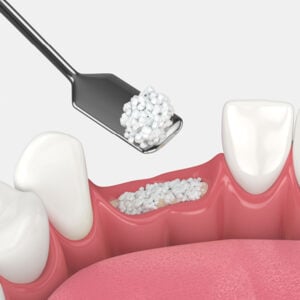
If you’ve ever been told you “don’t have enough bone” for a dental implant, it can sound like a dead end. The good news: modern dentistry has made bone regeneration a common, predictable part of implant planning. Dental bone grafting is a routine procedure performed by general dentists and specialists like periodontists and oral & maxillofacial surgeons to help rebuild jawbone so implants can be placed in the healthiest, most natural position possible.
When a tooth root is no longer present (after an extraction or long-term tooth loss), the bone in that area can begin to shrink over time. This is one reason replacing missing teeth sooner rather than later can be so important.
For patients planning on a future dental implant, maintaining bone volume after an extraction is critical. The implant replaces the tooth root, and it needs enough healthy bone to anchor into. Bone volume helps your dentist place the implant in the ideal position, which supports proper crown placement (the visible tooth part) for a result that looks natural and functions comfortably.
Socket Preservation
Today, many dentists recommend placing a bone graft at the time of extraction when an implant may be considered later. This is often called socket preservation, and the goal is to reduce the chance of a “gap” or collapse of the bone as the area heals.
Despite how it sounds, a bone graft isn’t usually a solid “chunk” of bone being put into place. In most cases, grafting material is added to an area where bone needs support, and your body uses that material as a scaffold to regenerate new bone over time. As healing progresses, the graft material is gradually replaced by your own bone.
Bone regeneration has become more predictable thanks to advances in wound healing science, materials, and surgical techniques.
How Do Dentists Rebuild Bone?
Bone grafting procedures often follow a similar concept:
- The gum tissue is gently opened to access the bone.
- Bone graft material is placed where bone needs to be rebuilt or reinforced.
- In many cases, the area is protected with a guided bone regeneration membrane.
Guided Bone Regeneration (GBR)
A GBR membrane is placed over the graft like a small protective cover. It helps keep the graft stable and shields the area from fast-growing soft tissue, giving bone cells the space and time they need to regenerate. Some cases also benefit from molecules that occur naturally in the body to help support the healing process.
Where Does Graft Material Come From?
One important factor is how much bone is needed. For a single-tooth implant site, the amount of graft material required is usually relatively small, which means your dentist or specialist has several options.
Common sources include:
Autograft (your own bone)
“Auto” means self. This involves using bone from another area of your jaw.
Allograft (donor bone from another person)
This is processed, sterilized bone from a human donor source.
Xenograft (from another species, typically bovine-derived)
Also processed for safety, commonly used as a scaffold material.
Synthetic graft material (man-made)
Biocompatible materials, designed to support bone formation.
All of these options are processed and prepared for safe use, and your dentist will recommend a material based on your anatomy, goals, health history, and the type of implant plan.
What is Bone Graft Recovery Like?
Most bone regeneration procedures are performed with:
- Local anesthesia (numbing medication), and/or
- Oral sedation or IV conscious sedation (a relaxed “twilight” state)
Your dentist may prescribe:
- Antibiotics to help prevent infection
- Anti-inflammatory and pain relief medication as needed
Healing timelines vary by procedure and by patient, but generally, grafted bone takes time to mature before it can fully support an implant in the way we want for long-term stability.
Do I Need a Bone Graft?
You might need bone grafting if you:
- Recently had (or need) a tooth extraction and want an implant later
- Have been missing a tooth for a while
- Have gum disease that affected supporting bone
- Need an implant placed in an area with thin or damaged bone
The only way to know for sure is with an exam and imaging (often 3D imaging/CBCT) so your provider can measure bone volume and plan the safest, most predictable approach.
Ready to take the next step?
Coast Dental has convenient locations across Florida, Georgia, and Texas. Request an appointment online or call (877) 880-1212 to discuss dental implants and bone grafting options.